The Kettle, the Mirror and the Door That Shuts: Reading the Bonnettes’ Rider
There is a moment, roughly an hour before doors, when a venue stops being a venue. The stage is still half-lit, the bar staff are counting glasses, and somewhere down a corridor a kettle is being asked to do hero work. For Bonnie and the Bonnettes, that moment is the real start of the show. Their touring rider — the document that tells each venue what the band needs — is not a grand declaration of rock-star excess. It is closer to a checklist for turning a room into a Bonnettes night.
A rider is just a room with the lights on
Plenty of riders read like a test. Ours reads like a handover. The Bonnettes’ list is built around a simple idea: the audience has paid for a night out, and the people making it happen need to be looked after enough to look after them. That means practical things, unglamorous things, and a few details that only make sense once you have stood in a cold dressing room in Carlisle wondering whether the mirror is fixed to the wall or merely resting against it.
In 2026, UK touring is a patchwork of arts centres, music halls, converted churches, club rooms and the occasional back room that smells faintly of chips. The rider has to work in all of them. So it asks for a kettle and a proper supply of tea, coffee and milk. Not a flask. Not a single sad sachet. A kettle. It asks for mugs — more than you think — because the band, the crew and the person who has just popped in to check the monitor mix all need one.
Tea first, glitter second
You can tell a lot about a band by what it puts first on the list. The Bonnettes put hot drinks near the top. That is not a joke about Britishness, although it is partly a joke about Britishness. It is about pacing. A gig day is long, and the gap between soundcheck and show can swallow a person whole if there is nothing warm to hold. Tea is a small ritual that slows the room down. It gives everyone a reason to sit for five minutes. It makes a dressing room feel less like a storage cupboard with a coat hook.
The rider also asks for water that is not warm, and snacks that are not purely sugar. This is the least glamorous paragraph in the document and possibly the most important. A pop night looks effortless from the front. From the back, it is a sequence of small physical tasks: lifting, tuning, taping, changing, checking, breathing. The rider is trying to make sure nobody is running on fumes by the encore.
The mirror has to be the right height
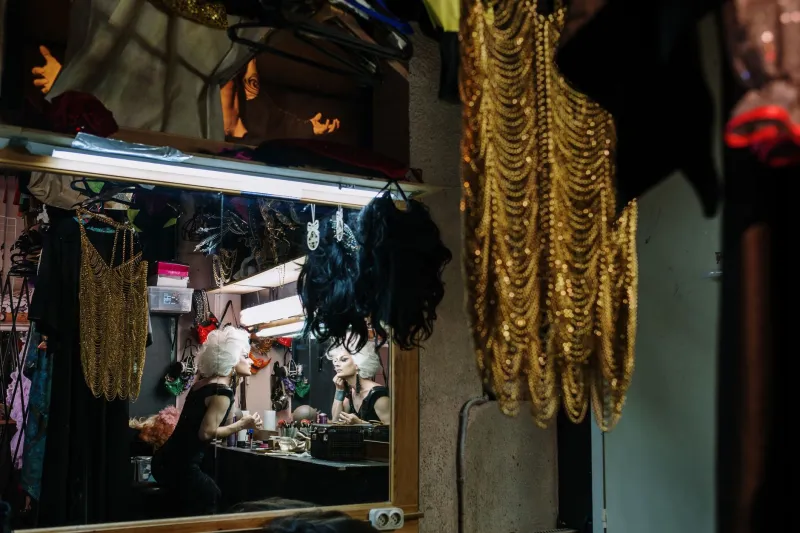
Then there is the mirror. The Bonnettes ask for a full-length mirror in the dressing room, ideally at waist height, with enough room to step back. Venues sometimes nod and produce a small bathroom mirror that shows one eyebrow at a time. The rider is polite about this, but it is specific for a reason. Retro-inspired stagewear is not a last-minute business. A hairclip has to sit where it was meant to sit. A collar has to lie flat. A sequin has to catch the light in the right place, or at least in a place Bonnie has agreed to.
The mirror is also about calm. The last twenty minutes before a show are not the time to discover that the only reflective surface is a dark window and a phone camera. A proper mirror turns getting ready into a shared ritual rather than a scramble. It lets the band check each other. It lets someone say, without fuss, that a strap is twisted or a fringe is doing something unusual. That is the sort of thing an audience never sees, but it is part of why the show looks together when the lights go up.
Spare hairclips and the economics of generosity
The spare hairclips are the detail that makes most sense once you have been on tour for more than three days. Hairclips vanish. They leap from dressing tables. They are borrowed and not returned. They end up in the bottom of a bag with a receipt and a broken plectrum. The rider asks for a small tin of them, and it is not because the band is precious about hair. It is because small failures have a way of becoming big distractions.
There is a wider point here about hospitality. A rider is not only for the artist. It sets the tone for everyone in the building. When a venue gets the small things right, the crew relax. When the crew relax, the changeover runs smoother. When the changeover runs smoother, the audience gets a better show. The Bonnettes’ list is full of these little handovers: a clear surface that is not sticky, a rail that can take the weight of a few jackets, a bin that is not a mystery. None of it is extravagant. All of it is about respecting the night.
The request that surprises every venue
The line that tends to raise an eyebrow is not the tea or the mirror. It is the request for a door that shuts properly — and a quiet twenty minutes behind it before doors. Some venues hear this and assume something dramatic is happening. In reality, it is vocal warm-ups, a last check of the setlist, and the kind of silence that is hard to find in a building filling up with people. A door that shuts is a small privacy request. It is also a boundary. It says: this bit is ours, and then the room is yours.
In a good venue, that request is easy. In a difficult one, it is a useful test of how the night will go. The Bonnettes are not asking for a fenced-off corridor or a security guard with a clipboard. They are asking for a door that does what doors are meant to do. It is hard to think of a more reasonable demand, and yet it is the one that often produces the most puzzled expression from a well-meaning venue manager holding a bunch of keys.
What the rider says about a Bonnettes night
Put the whole list together and a picture emerges. The Bonnettes want a room that is warm, practical and ready to be transformed. They want the people around them to have what they need. They want the small rituals protected, because the small rituals are what keep a tour from becoming a blur of service stations and strip lights. And they want the audience to walk in and feel that something has been prepared, even if they cannot name what.
That is the thing about a rider. It is not really about the tea. It is about the standard behind the tea. A proper UK pop night in 2026 is not built in the moment the first chord lands. It is built in the hour before, when someone puts the kettle on, someone else checks the mirror, and a door finally clicks shut.